


Insurance companies evaluate personal injury claims through a specific internal process: reserve-setting based on injury codes, a multiplier applied to medical bills, and a first offer designed to close the file before the claimant understands what the case is worth. Knowing this process changes how a claimant responds to it.
Attorney Mark T. Stern spent over a decade evaluating injury claims from the defense side with major national and international insurance companies as Senior Claims Adjuster, Field Adjuster and Litigation Specialist before becoming a Florida personal injury attorney.
That background gives him direct knowledge of how insurance adjusters set reserves, apply settlement multipliers, and use recorded statements to assess and evaluate claims.
Key Takeaways
- Adjusters set a financial reserve on a claim within days of the first report, often before full medical records are available.
- Soft tissue injuries receive the lowest multiplier — typically 1.5x to 2x of medical bills — because they’re the hardest to verify objectively.
- Recorded statements are evidence-gathering tools for the adjuster, not a formality, and a claimant’s own words can lower the claim’s value.
- Florida Statute §624.155 provides claimants with a bad-faith remedy when an insurer fails to negotiate fairly and honestly.
Speak with an attorney who has worked both sides of a claim. Call the Law Offices of Mark T. Stern at (954) 772-6800 for a free consultation.
Background as an Insurance Claims Adjuster
Attorney Stern worked at Farmers/Zurich Personal Insurance in Rocky Hill, Connecticut, from 1994 to 1999 as a Senior Claims Representative and Litigation Specialist, investigating liability claims, evaluating injuries, and negotiating bodily-injury and uninsured/underinsured-motorist claims throughout the North East.
He prepared litigation plans for defense counsel and assisted in investigating a fraud ring identified in the claims he handled.
From 1999 to 2002, Stern worked at an independent adjusting firm in Madison, Connecticut, as a Casualty Claims Adjuster, performing field investigations, securing statements from claimants and attorneys, and evaluating and negotiating injury claims to resolution.
He earned his J.D. at Quinnipiac University School of Law and was admitted to the Bar in Connecticut in 2002, New York in 2003 and Florida Bar in 2009.
How Adjusters Set a Reserve on a Claim
A reserve is the dollar amount an insurance company sets aside to pay a claim, and it is established early — often within the first week — based on the initial injury report, police report, and policy limits. The reserve isn’t the settlement offer, but it caps what the adjuster can authorize without escalating to a supervisor.
An adjuster working from a low initial reserve has less authority to negotiate upward without internal approval, which slows the case down and gives the adjuster a built-in reason to argue the claim is worth less.
Adjusters typically revisit the reserve at defined intervals — when new medical records arrive, when treatment concludes, or when a demand letter is received — and each revision requires the adjuster to justify the change to a supervisor in writing.
Sending a complete medical record and wage documentation early forces an earlier revision, so the claimant isn’t negotiating against a figure set before treatment was finished.
How the Multiplier Method Values Pain and Suffering
Adjusters commonly use a multiplier method: they take total medical bills and multiply that figure by a number — typically 1.5 to 5 — based on injury severity, to estimate pain and suffering. The multiplier is the single biggest lever in the entire claim, and it’s also the number adjusters are trained to keep low.
The table below reflects general industry practice as described in claims-handling literature, not a figure set by Florida statute.
| Injury Type | Typical Multiplier Applied |
| Soft tissue (whiplash, sprains, strains, no imaging) | 1.5x – 2x medical bills |
| Moderate (fractures, herniated discs, documented imaging) | 2.5x – 3.5x medical bills |
| Surgical or permanent injury | 3x – 5x medical bills |
| Catastrophic, permanent disability | 5x medical bills or higher |
Whiplash, sprains, and strains without imaging evidence typically draw the lowest multiplier because adjusters can argue the injury isn’t objectively verifiable on an X-ray.
Surgical or permanent injuries draw the highest multipliers, which is why adjusters scrutinize treatment gaps and push back on chiropractic-only treatment plans for soft tissue claims.
Gaps of two weeks or more between treatment visits are a specific marker adjusters flag internally as “treatment abandonment,” and they use that gap to argue the claimant either recovered early, or the injury was never as severe as documented.
Adjusters are trained to open at the low end of the applicable multiplier range because a file closes faster when the claimant accepts the first number rather than pushing back. The opening offer is the starting point of negotiation, and it does not represent the adjuster’s actual settlement ceiling.
Why Recorded Statements Work Against the Claimant
A recorded statement is a formal, transcribed interview that the adjuster uses to lock in a claimant’s account of the accident and injuries, and it becomes evidence that the company can use against the claim later.
The questions are structured to surface inconsistencies, minimize injury descriptions, and shift fault percentage under Florida’s comparative negligence rule, the same tactic described in legal advice for car accident victims facing insurance company pressure.
- Casual language like “I’m fine” or “it’s not that bad” gets flagged and quoted back later as evidence that the injury is less serious than the demand claims. Casual conversation can be used admissions and later used against you.
- Statements about how the accident happened are compared word-for-word with the police report to identify any inconsistencies.
- Comments that assign any share of blame to the claimant are used to argue for an upward adjustment of the fault percentage under Florida’s comparative fault rule.
- Open-ended questions about pre-existing conditions or prior accidents are designed to surface anything the adjuster can later argue caused the injury instead of the crash.
- Claimants are under no obligation to give a recorded statement to the at-fault driver’s insurer.
Speaking with an attorney before any recorded statement protects a claimant from giving away leverage they don’t know they have. Calls are being recorded when you call an insurance company. Do not call yourself, allow your attorney to represent you and deal with the insurance company.
Why the First Offer Is Designed to Close the File
Insurance adjusters operate under a consistent incentive: close files quickly, keep payouts low, and protect the loss ratio the company reports to its regulators. The first offer reflects that incentive, not the actual value of the claim.
An adjuster discounts a demand that’s missing future medical costs, lost earning capacity, or a clear causation link between the accident and treatment, because an undocumented gap gives the adjuster a reason to argue the number down.
A complete demand package — past and future medical costs, wage documentation, and a multiplier-supported pain-and-suffering figure — removes that opening before the adjuster ever responds.
Florida Statute §624.155 allows a claimant to bring a civil action against an insurer that fails to attempt in good faith to settle a claim when, under the circumstances, it could and should have done so.
If an insurer ignores a properly documented settlement offer or unreasonably delays evaluating a claim, that conduct may support a bad faith claim under Florida law as of 2026, with the formal process governed by Florida’s Unfair Insurance Trade Practices Act.
How to Respond When a Claim Is Being Evaluated
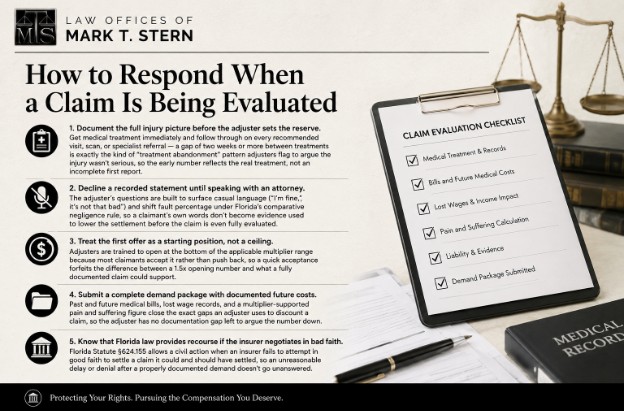
- Document the full injury picture before the adjuster sets the reserve. Get medical treatment immediately and follow through on every recommended visit, scan, or specialist referral — a gap of two weeks or more between treatments is exactly the kind of “treatment abandonment” pattern adjusters flag to argue the injury wasn’t serious, so the early number reflects the real treatment, not an incomplete first report.
- Decline a recorded statement until speaking with an attorney. The adjuster’s questions are built to surface casual language (“I’m fine,” “it’s not that bad”) and shift fault percentage under Florida’s comparative negligence rule, so a claimant’s own words don’t become evidence used to lower the settlement before the claim is even fully evaluated.
- Treat the first offer as a starting position, not a ceiling. Adjusters are trained to open at the bottom of the applicable multiplier range because most claimants accept it rather than push back, so a quick acceptance forfeits the difference between a 1.5x opening number and what a fully documented claim could support.
- Submit a complete demand package with documented future costs. Past and future medical bills, lost-wage records, and a multiplier-supported pain-and-suffering figure close the exact gaps an adjuster uses to discount a claim, leaving no documentation gap to argue the number down.
- Know that Florida law provides recourse if the insurer negotiates in bad faith. Florida Statute §624.155 allows a civil action when an insurer fails to attempt in good faith to settle a claim it could and should have settled, so an unreasonable delay or denial after a properly documented demand doesn’t go unanswered.
Attorney Stern brings firsthand knowledge of how adjusters build their cases to every personal injury claim he handles. Call him at the Law Offices of Mark T. Stern at (954) 772-6800 for a free consultation.
Frequently Asked Questions
How quickly does an insurance company set a reserve on a claim?
Reserves are typically set within the first week after a claim is reported to the company, based on the initial injury report, the police report, and the available policy limits, often before full medical treatment is documented or even complete.
What multiplier do insurance companies use for pain and suffering?
Adjusters commonly apply a multiplier ranging from 1.5 to 5 times the total medical bills incurred to estimate pain and suffering, with soft-tissue injuries drawing the lowest multipliers and surgical or permanent injuries drawing the highest within that range.
Should a claimant give a recorded statement to the insurance adjuster?
Claimants are under no legal obligation to give the at-fault driver’s insurer a recorded statement of any kind, and speaking with an attorney before giving any statement protects against language that could later be used against the claim’s overall value.
Why is the first settlement offer always so low?
Insurance adjusters are trained to start every negotiation at the very bottom of the applicable value range because many claimants simply accept the first number offered rather than push back with documentation supporting a much higher settlement figure overall.
What is insurance bad faith under Florida law?
Under Florida Statute §624.155, bad faith occurs when an insurer fails to attempt in good faith to settle a claim it could and should have settled, acting fairly and honestly toward the claimant and with due regard for the claimant’s stated interests.
Does having an attorney actually change the settlement value?
Yes. A documented demand package that closes the gaps adjusters typically look for, including future medical costs, lost wage documentation, and causation, removes the leverage an adjuster otherwise uses to justify a lower settlement number during negotiation with the claimant.
Why do soft tissue injuries get valued so low by insurers?
Soft tissue injuries generally don’t show up clearly on X-rays or standard imaging, so adjusters can argue the injury isn’t objectively verifiable, which supports applying the lowest multiplier in the standard 1.5x to 5x range used industry-wide for these claims.
Can the insurance company use social media against a claim?
Adjusters and investigators do routinely review a claimant’s public social media activity for any content that contradicts the claimant’s own stated injuries or physical limitations, so claimants should always remain cautious about what they post publicly during an active claim.
What happens if there isn’t enough medical documentation?
A documentation gap gives the adjuster a clear basis to argue the injury is less serious or less causally connected to the accident than the claimant alleges, which directly lowers both the multiplier applied and the final settlement offer that follows.
How long does the insurance company have to respond to a demand?
Florida Statute §624.155 ties bad faith exposure to a 60-day cure period after notice of a violation is properly filed with the insurer, with a separate, additional 90-day window applying to certain liability tender situations under that same Florida statute.
Is an adjuster on the claimant’s side if it’s their own insurance company?
Even a claimant’s own insurer evaluates the claim with an eye toward minimizing the eventual payout amount owed, since the company’s financial interest is always to close out the claim for as little documentation as Florida law will allow.
What should a claimant do before speaking with any insurance adjuster?
Speaking with a personal injury attorney first, ideally one who understands exactly how adjusters internally evaluate and value claims, before giving any statement or accepting any initial settlement offer, is strongly recommended in nearly every single such claim situation today.
Get a free consultation from an attorney who evaluated claims from the inside. Call the Law Offices of Mark T. Stern at (954) 772-6800.